Posted By Eric Swarthout,
Wednesday, December 28, 2022
(PLEASE NOTE ATTACHED FILES )
Through a change in NY Tax Law 1449-BB and changes to Town code in the towns that make up the Peconic Bay Region, we will see two changes to the way the CPF tax is calculated this year.
January 1, 2023
For Conveyances occurring on or after January 1, 2023 the exemptions amounts have changed in two ways, as detailed in the chart below
The allowance or exemption for Improved properties has been increased in East Hampton, Shelter Island, Southampton, and Southold. Riverhead remains the same. The allowance or exemption for Unimproved properties remains the same in all five towns.
For Conveyances in East Hampton, Shelter Island, and Southampton a new exemption cap has been implemented. For these three towns, no exemption is to be applied to transfers greater than or equal to $2,000,000.
A copy of the new Peconic Bay Region Community Preservation Fund form is attached for conveyances occurring on or after 1/1/2023.
April 1, 2023
For Conveyances occurring on or after April 1, 2023 the tax rate has been increased from 2.0% to 2.5% in East Hampton, Shelter Island, Southampton, and Southold. This is the implementation of the ½ percent Community Housing Fund (CHF) adopted by local referendum in November.
An updated form is not yet available and will be circulated once published.
Minor Technical correction to clarify that powers of attorney need only to have been executed by the principal and conform to the law in effect at the time executed by such principal to remain valid and enforceable under the new law, even if signed by the agents at a later date.
U.S. Reps. Blaine Luetkemeyer (R-MO) and Brad Sherman (D-CA) recently
forwarded correspondence to the Federal Housing Finance Agency (FHFA)
Director Sandra Thompson, noting concerns regarding the potentially
harmful impact of title insurance alternatives.
“The plans aim to lower closing costs and make homeownership more
accessible for low- to moderate-income and minority homebuyers,” the
legislators wrote. “However, these initiatives appear to risk exposing
these consumers to harm by not providing the same consumer protections
as title insurance. They also raise concerns about the safety and
soundness of the Enterprises (Fannie Mae and Freddie Mac), increase
taxpayer risk which FHFA must consider as the GSEs’
(government-sponsored enterprises) regulator and conservator.”
Luetkemeyer, top Republican on the Subcommittee on Consumer
Protection and Financial Institutions, and Sherman (D-CA), top Democrat
on the Subcommittee on Investor Protection, Entrepreneurship, and
Capital Markets, said the plans position low and moderate-income and
minority borrowers at risk of going uninsured against average home buyer
common title defects.
“As a result, the attorney opinions imperil the ability of these
consumers to be compensated for title issues,” the legislators
concluded. “Attorney opinions increase the likelihood these precarious
homeowners lose their house and lose the ability to build wealth. The
differences between attorney title opinions and title insurance can be
confusing to policymakers, mortgage lenders, and legal practitioners. We
expect FHFA to address these concerns in a timely manner, prior to
approving the expansion of any Enterprise closing cost pilot, in order
to give Congress the opportunity to engage further on this important
matter.”
Here is a link to the recently passed Healthcare Lien legislation, which is still under review by the Legislative Committee to consider its impact on the title insurance business,
Finally, the Title Tidbit topic was, "Not-for-Profit corporations’ disposition of assets and the approvals required." Attached you will find two documents issued by the NY Attorney General, which provide guidance on such issues.
EXECUTIVE COMMITTEE MEETING New York State Land Title Association Via ZOOM December 13, 2022 10:30 AM
AGENDA 1. Call to order – President Swarthout
2. President’s Greeting – President Swarthout
3. Approval of November Minutes - Executive Director Treuber
4. Exec Director Report – Executive Director Treuber a. Approval of the FY 2023 Budget b. Approval of the Mercury contract c. Approval of the Wall of Honor Proposal
5. Treasurer’s Report – Mr. D’Addona
6. Title Section Report – Chair Schwartzman
7. Agent Section Report – Chair Giliotti a. Getting close to no more Rin and RON rules b. Health Care Liens- Where do we stand? c. Suffolk time frames d. Suffolk add 'l taxes e. Where do we stand with new by law changes f. Writing a letter to the Department of Taxation about late fees in Suffolk g. PAC update on how our candidates did.
Issued by Suffolk County Clerk at 3:29 PM Sept.30, 2022
SCCO Alerts<Sccoalerts@suffolkcountyny.gov>
As
many of you know, we have asked those examiners in the building to test
our new computer configurations in the Public
Access room with the goal of being ready to go live Monday at 8:00
a.m. We have been working closely with the County Executive and the
Governor’s office to make sure we have the necessary resources to be
fully operational in a very short period of time.
In
furtherance of verifying the readiness of the new computer
configuration we are opening up testing sessions again tomorrow for a
limited
number of terminals for portions throughout the day.
We
are making 50 terminals available for a morning shift from 9:00 a.m to
12:15 p.m.. We will have a second afternoon shift from 1:00 p.m.
to 4:30 p.m.
If you are interest in helping further test during these shifts please respond to this e-mail with your:
Name Company Name E-mail Address Cell phone number
This
is available for the first 100 individuals who volunteer. The shift you
are provided will be assigned to you and can not be assigned to
another individual.
E-mails with multiple requests will not be accepted. Each individual must respond from their own e-mail address.
We
will notify you by the end of business day which session you have been
assigned to. We will notify everyone once all spots are filled.
It
is our goal to make sure the testing provides the necessary feedback we
need to help ensure a smooth official opening Monday morning. Thank
for your continued patience and cooperation as we look forward to
officially opening again Monday morning.
Over the last several days we have been working hard to bring back the applications used to perform title searches. Our IT staff, along with the County IT staff,
have worked around the clock to get us to the point where can open our office for searching Monday at 8:00 a.m.
We will have roughly 120 terminals available throughout the Clerk’s Office for searches to be conducted. At this
point we believe all of the programs you are accustom to using will be available. There are still some issues we are working out through testing which we hope to resolve over time. There are currently two printers available and we are working
towards bring additional ones online.
What to expect.
Please expect the system to be slower than you may be accustom to. We know this to be an issue and are working in the background to alleviate the issue over time.
While we believe there will we sufficient work stations available, in
the event there is not, we ask that you be respectful and allow others access when you know the terminal will not be used for a period of time. We understand the demands being placed on you and the amount of work that has accumulate over the last
two weeks. It is important we all work together.
The building will be open near normal business hours to start as we assess our computer equipment capacity and provide necessary maintenance. It is our goal to increase business hours once
we confirm the computer environment can handle the increased volume of use.
Your cards will be required to print and you may add funds to them by filling out the attached form and leaving it with the Public Access counter staff. We will
add the funds to your cards throughout the day starting Friday so they will be available for use Monday morning. Payments need to be made by check and we can add funds to only one card per check (in the short term). This form will also be available
at the counter by the printers.
As for recordings and other related filings, our staff will be working towards getting our systems up to once again provide those services. I do not have any timeframe that can be provided but please be
assured we are working as hard and fast as possible to get those functions up and running soon. We will provide further details as we progress.
We appreciate your patience as we work through this difficult and unprecedented situation.
We are sure by working collectively and with respect for one another we will get through this period and return to “normal” in due course.
Unfortunately, the countywide shutdown of all computer services is still in effect. Our County Clerk IT, County IT and cyber security experts have been working around the clock to try and get us back up and running as soon as possible. This is an enormous task and the county is putting all of it’s resources towards it.
While we do not have much new news to offer, County Clerk staff will be available in the cafeteria in the Riverhead County Center on Friday at 10:00 a.m. to answer any questions that we can. As many of those who have visited the building over the last couple of days can attest to, there are still many questions that we can not answer both in the short term and long term.
We understand the impact the shutdown has had on the title and real estate industry as well as your businesses and livelihoods. We greatly appreciate your continued patience as we try to move through this collectively.
Suffolk County on Long Island joined the ranks of those hit by a ransomware attack, and the results and impact are not surprising. One headline on September 13 somewhat said it all: “County IT systems crippled, with websites, email down, five days after discovery of cyberattack.”
By yesterday, county officials were working to send out paper checks to pay county vendors, with Newsday reporting that nonprofits contracted to perform social services were a high priority for payment.
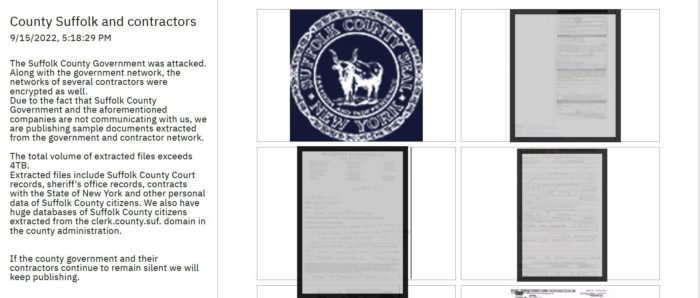
Then a ransomware team stepped out of the shadows to claim responsibility for the attack. Variously called ALPHV or “BlackCat,” they issued a post on their dark web leak site:
The Suffolk County Government was attacked. Along with the government network, the networks of several contractors were encrypted as well.
Due to the fact that Suffolk County Government and the aforementioned companies are not communicating with us, we are publishing sample documents extracted from the government and contractor network.
The total volume of extracted files exceeds 4TB.
Extracted files include Suffolk County Court records, sheriff’s office records, contracts with the State of New York and other personal data of Suffolk County citizens. We also have huge databases of Suffolk County citizens extracted from the clerk.county.suf.
domain in the county administration.
The post was accompanied by screencaps of various files that appear to have been exfiltrated from county systems.
BlackCat added Suffolk County to their leak site. Redacted by DataBreaches.net
Visitors to the county’s website today will see this notice:
Following an alert of unusual activity on Thursday September 8th, 2022, out of an abundance of caution the County took aggressive containment measures, which included taking email and web-based services offline.
Below you will find contact information for the County’s various departments and agencies. For general inquiries please call Suffolk County 311 by dialing 311 or 631-853-6311.
Media coverage of the Suffolk County computer outage has focused on public safety issues. We have not seen official reports related to land recordation.
The following links were posted September 13th and 14th.
The New York State Land Title Association, Inc. advances the common interests of all those engaged in the business of abstracting, examining, insuring titles, and otherwise facilitating real estate transactions. The Association promotes the business
and general welfare of its Members and protects real property title holders’ ownership rights.
 Print Page
 Blog Home
 All Blogs
 RSS
RSS